
How To Craft a Cookbook


Eats and drinks are topics that get many writers’ creativity flowing. I have taught several food writing classes in recent years because intense enthusiasm for culinary-related content was primarily what fueled my freelance career at the beginning. Hence when I got the chance to create a cookbook as an IP project in 2022, I was ecstatic! Little did I know, however, how much work it would be. In addition to writing all of the introductory material, I had to come up with over 50 recipes, in addition to styling and photographing each one. Food styling and photography are skills I (thankfully) managed to significantly improve during the four years I spent on staff at a women’s lifestyle magazine. But they are not talents every cookbook author necessarily needs. The process of developing a cookbook varies depending on one’s professional background, subject matter, and pathway to publication. Which is what makes the following behind-the-scenes peek into the journeys of two debut cookbook authors (Abby Cheshire and Rawlston Williams) a mini master class on how food is a vital component of identity — in the places we visit, people we know and ourselves.
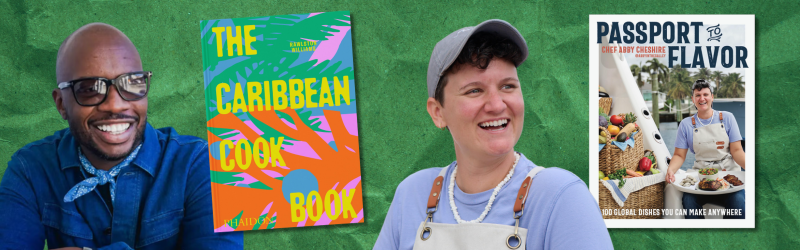
Abby Cheshire is a private yacht chef, culinary arts teacher, and social media influencer. When she’s not teaching her high school students during the school year, Abby spends her summers traveling around the world and cooking global cuisine on a yacht. Her popular social media accounts share videos of her unique cooking experience and ability to create fabulous meals in small spaces, on the high seas, or anywhere with local and fresh ingredients.
Rawlston Williams is a Caribbean chef with a deep passion and knowledge for his region’s food culture. Born in Kingstown in Saint Vincent and the Grenadines, he has lived in New York since 1987. A graduate of the French Culinary Institute, for many years he was the chef-owner of the award-winning Brooklyn restaurant The Food Sermon, which focused on dishes inspired by Caribbean cuisine.
Describe how you have witnessed the role food plays in Caribbean culture.
RW: It helps to frame our identity in a lot of ways. Think of it as a bookmark for the history of each place. For example, some of the islands' cuisines are more tied to India like Trinidad. Whereas Jamaican recipes reflect how Spanish, Chinese and British cultures had more of an influence there. Also, I think a lot of traditional Caribbean cooking showcases are innate resilience. Our ancestors learned to use whatever was available to them in terms of ingredients. The leftover parts of vegetables. Scraps of meat. They became quite skilled at making “the refused” delicious.
Explain a bit about how you have infused details about the countries you visited into your cookbook.
AC: Every chapter of Passport to Flavor is meant to feel like stepping off a yacht into a new country. I didn’t want it to be just recipes—I wanted readers to feel the place. I've had the chance to travel to many countries around the world, and those experiences have deeply influenced the cookbook. Each chapter includes real stories and cultural insights from my travels. Unfortunately, the pandemic postponed my planned month-long trip to Asia, where I was excited to dive into the cuisine and street food. (Asian food is my specialty.) Even so, I've immersed myself in learning through cookbooks and conversations with experts here in the States. That passion and knowledge definitely shine through in the book. And for all the other places I’ve visited, every story is authentic and comes from amazing experiences around the globe.
Did you always want to write a cookbook? Is this book what you first first envisioned creating?
RW: No. In fact, I feel like anything that has happened to me professionally in relation to food is not something I have wished for outright. Also I actually ended up having to write this book twice. The first time I wrote it (a couple of years ago) my laptop was stolen in the Caribbean and I didn’t have any of the files on the computer backed up. The publisher graciously agreed to wait while I started over. And I admit that this version of the manuscript really pulled me out of my comfort zone. I feel like through its creation, I have evolved into another sphere as a culinary professional.
Which had the most influence on the recipes you included: people, places, events, or ingredients?
AC: It actually depends on where I am! When I’m on land, people and the type of event play a huge role in shaping the recipes. I consider what the guests enjoy and the atmosphere of the occasion. But when I’m on the yacht, it’s all about the ingredients available at the port. I often have to adapt on the fly by checking out local grocery stores and creating dishes based on what’s fresh and available. It’s a fun and spontaneous process!
Share one of your earliest memories related to food or dining out while traveling.
AC: My earliest memories come from my Italian family’s kitchen where I’d sit on a stool with my Gigi and Nana. Food was the heart of our home; every gathering revolved around the dinner table. That love for cooking and family traditions really shaped me. Moreover, my family always encouraged me to try new foods and explore different cuisines without fear. That openness has carried into my travels because I never say no to trying something new. It’s made every journey a delicious adventure!
RW: As a kid, I was always greeted by the smell of fresh baked bread coming home from school on Fridays. Knowing I could break off a piece right away, and enjoy it with butter on top, was THE BEST. So if I smell that anywhere in the world, it takes me back to that feeling of simple childhood joy. I also have a strong scent memory triggered by stewed chicken because I grew up vegetarian and didn’t eat meat until I came to the US in 1987. The aroma of stewed chicken flowing out of neighbors’ windows was the only way I consumed meat for the first 10 years of my life.
How has your cooking style evolved over the years?
AC: My cooking style has definitely transformed over time. In catering, I’d work with set menus for events, so guests would only taste my food once. But on the yacht, it’s a completely different ballgame! I need to keep things fresh and exciting for guests who are with me for weeks at a time. Imagine tasting new dishes every day! So I never repeat a dish and always switch up the cuisine. I start with the protein then go from there. Showcasing my cooking on TikTok has also been a voyage. I started out pretty off-the-grid and learned filming and editing on the fly. Over the past five years, I’ve definitely grown in my skills, picked up some new camera gear, and my content has become a lot more polished and engaging.
RW: I am now able to have more restraint in the kitchen when it is needed. The excitement of wanting to constantly consume and explore when I was younger has given way to a broader perspective on how to craft an excellent meal. A lot of what I make now, I have exactly personally consumed in or near a recipe’s roots in terms of location and/or community. So I actually lived the food (via my own palate) rather than simply trying to imitate another cook’s version. My imposter syndrome is also not as dominant as it used to be. I feel more confident that I belong in this space. Vulnerability for me now is a superpower.
What content in your cookbook might be especially helpful for novice chefs or cookbook creators?
AC: My cookbook is all about being approachable and encouraging everyone to feel confident in the kitchen. I call my followers "little chefs" to inspire them and give them that motivation that they can do it. The recipes are straightforward and come with helpful hints, what I call "Rogue Wave," to avoid common pitfalls. Plus, there are "Alternate Course" sections for ingredient substitutions. So you never have to worry if something's unavailable. Then there’s "Throttle Control," which encourages readers to get creative — adding more spice or sweetness to suit their tastes. Ultimately, I want everyone to feel like they can make these dishes their own and have fun with the process!
RW: You may not get it the first time. Many of these recipes have never been written down. Most of these recipes have been passed down through families and “hands on experience.” That's why, in my opinion, you can taste the love in it. You likely will have to prepare these dishes a few times to make it your own by finding the ingredient ratio you like the most. Think of the recipes in my cookbook as the foundational pieces. But give yourself permission to be resourceful and use what you have on hand or most appeals to your palate.