
How to Create a Graphic Novel
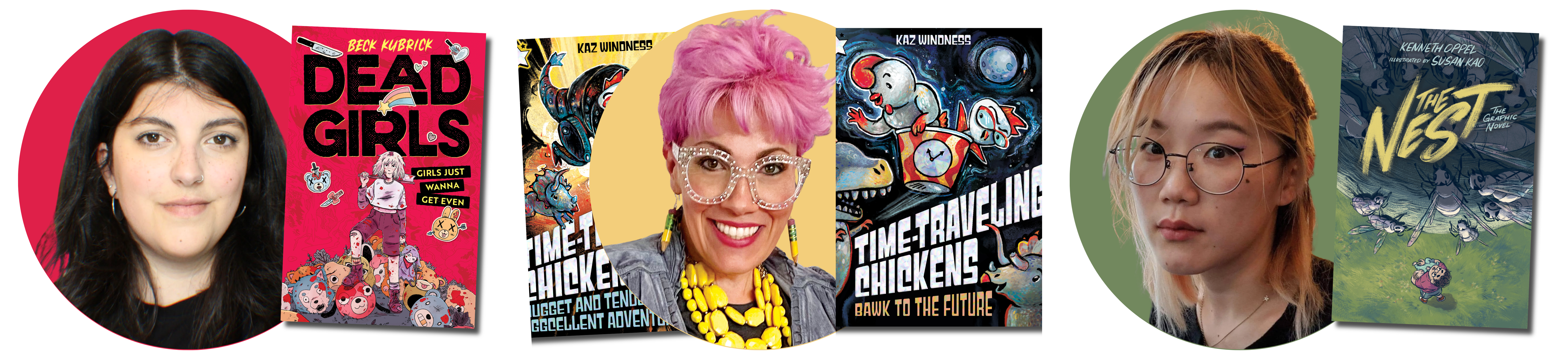
Writers are artists. This is a factual statement that some folks try to debunk. The truth is many of us who write for a living are also simultaneously engaged in other creative endeavors. For me, that happens to be food styling and photography. And I know more than one author whose day job or side hustle involves content creation such as podcasting, videography or graphic design for social media and email marketing. Then there are those whose narratives come alive through visuals created with their own hands. This artwork, when paired with words, then become comics or graphic novels. Author-illustrators Beck Kubrick and Kaz Windness, along with illustrator Susan Kao, explain how this process unfolds for them in this month’s ‘how to’ Q&A.
What most influences your artistic rendering of the characters and settings of the stories you bring to life on the page?
SK: One of my best friends in high school introduced me to Craig Thompson's beautiful graphic novels. They were some of the first comics I really got into outside of Garfield and Archie. His expressive lines and layouts really captured my attention. They're wonderfully loose and flowing in such a natural-feeling way.
BK: At the risk of sounding very pretentious, I very much subscribe to David Lynch’s concept of the unconscious and how we come up with ideas. He describes it as a body of water and our conscious mind is fishing in it. Everything percolates under the surface: our memories, our imagination, our experiences etc. and then…we catch a fish! I can unpack some of the things I like such as my childhood house backed onto the woods. Now I love stories about the woods and forests. I was always a weird kid, so I like stories about weird people and horror. There’s probably way more things I’m unaware of. For artistic rendering, I’m always trying to hit the sweet spot of drawings that look like drawings. Like if you can see the flaws or the brushstrokes or the pencil lines that didn’t get fully erased, but without these flaws being distracting. I’m also always trying to create clarity for the reader so they can tell what’s going on easily. And hopefully, it’s aesthetically pleasing too. I’m not really interested in super representative art within my stories. During an intense moment, the art style may become more frantic or the colors more bold to serve the story plus mirror the characters feelings or experiences. Whenever I’m stuck I look up how The Simpsons did it. because they’ve done everything. And they usually take the simplest route so I can build from there.
KW: This is pretty specific, but the 1989 “Dear Diary…” Garfield wall calendar (created with oil paints) by Mike Fentz. That artwork blew my teenage mind and still influences my illustration approach. My character style is cartoonish, but I paint in heavily textured, richly detailed ways.
Do you write the text before creating the visuals? Or vice versa?
SK: In the case of The Nest, very handily Kenneth Oppel had already written the entire story as a separate novel years ago. On the occasions where I've written some of my own work though, I kind of do both at the same time: the art informs the writing and vice versa.
BK: My favorite way of working is to have a skeleton of a story so all the important twists, character arcs and the ending are planned out. Then I work out the specifics on the page, like dialogue or staging. When working with other people — such as editors and publishers — I have to have a bit more of a plan. However, for my self-published work like my first printed comic I made in 2021 (Coby, Alone), I drew the whole thing pretty loosely in a sketchbook first. Most of the final pages, paneling and dialogue are one to one. Even when I write a script for an editor to read first, I’ll be planning moments, jokes, scenes via sketchbook doodles, notes, and layout drawings. I just then reverse engineer that into an actual legible script. So the art and words always exist together in some way for me.
KW: I go back and forth. Usually, the idea appears as a character in my sketchbook. Often that sketch turns into a one-panel comic. From there, I’ll start asking myself ‘What would happen if?’ questions. Next, I’ll start typing out the answers. If the idea has legs, I’ll write a rough draft. If I get stuck, I’ll draw some more, then go back to writing. It’s definitely both: creating the art and text in tangent. I'm always seeing pictures in my head, even as I’m focused on the words part.
What is your favorite medium or tool to make art with?
SK: A soft pencil! This includes both physically, and digitally recreated, pencil brushes. There's just something about the tactile texture and expressive sketchiness that I love. My dad was also a graphic designer. And growing up, he would have tons of random pencils laying around — sharp drafting pencils, big charcoal-y ones, waxy grease pencils that you had to pull on a little string to sharpen. I lived in a plethora of pencils!
BK: I love oil paint. It’s got so much texture and depth. My favorite artist of all time (Francis Bacon) used it to make weird portraits that I love. One of the pages in my book (Dead Girls) was done in oil paint. One day I will commit to making a comic in oil paint. At the complete opposite end of the spectrum, I love ink, pencils and paper. I especially like cheap fineliners and mechanical pencils, then use on whatever’s around: post it notes, old envelopes, my sketchbook. Very minimal lines and obvious imperfection preferably. The comic How to Look at Art by Lynda Barry is one of the best examples. Not to say it’s ‘imperfect’, but there’s a minimalist approach and spontaneity to it that I adore.
KW: My favorite art creation supplies are China marker, ink brush pen, Quick-StiX and collage. I don’t use any of that for my children’s book illustrations (yet), but I love expressive mark making. My illustrations usually start as pencil drawings in my sketchbook painted digitally on a laptop.
Check out Rachel’s upcoming class for our Diversifying Writers series: Resource Sharing for Indigenous and BIPOC Writers on Nov 7 & 14 at the Loft at Open Book in Minneapolis!