
How to Write A Romance Book

 No writer is a master of every genre. Many of us experiment with welding our pens like a wand in an attempt to transform classic craft elements and plot twists into original narratives. And I truly think romance authors are the most challenged in this regard. Are there still that many love stories left untold? Or how does one invent a fresh take on romantic tropes such as love at first sight, star-crossed lovers or best friends secretly wanting more?
Since these types of storylines do not fall within my writer’s wheelhouse, I asked two authors whose books primarily center the affairs of the heart to explain how they laid the track to traditional book deals — and are currently cashing in on this success.
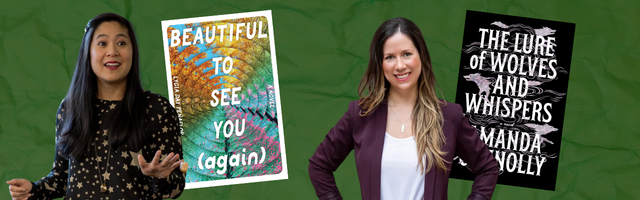
Lygia Day Peñaflor is the critically acclaimed author of Creep: A Love Story, All of This Is True, Unscripted Joss Byrd, and Beautiful to See You (Again). Her novels have been published around the world in over a dozen languages. And Amanda Connolly is a Canadian political journalist and editor. A winner of the EU-Canada Young Journalist Fellowship, she is a dual citizen of Canada and Ireland.
What initially gave you the inspiration to write a romance book?
LDP: I never really approach my novels with thoughts of a specific genre. I usually just aim to write something that feels real, so I didn’t specifically set out to write a romance. I thought of Tia’s character. Her story centered around her grief over a lost love. When I gave her a potential new love interest, of course it was going to be a romance — a love triangle between the past and the present, in fact! But at first, I was focused on developing a book about loss and healing.
What makes your book "romantasy"?
AC: The Lure of Wolves and Whispers is a dark fantasy/romantasy. I think it very much belongs on the fantasy shelves (instead of the romance shelves). Although I am a huge fan of romance myself. I’ve also been a lifelong lover of fantasy books. So when I set out to try to write my own books 13 years ago, there was never any question that it was going to be fantasy that I gravitated toward. Plus I’ve always loved fantasy stories that include romantic plots, however, we didn’t have the name “romantasy” until recent years.
Do you usually invent your characters or the overall narrative first?
AC: For me, I have to hear the character’s voice before anything else. I wrote five books that went nowhere before The Lure of Wolves and Whispers — through which I definitely learned that if I try to force a story before the character is ready and before I hear their voice in my head, then the story is not going to be good. I always start with the character in first-person narration because I need to know how they see and interact with the world to understand the structure, limitations and opportunities of the world itself…and how I can weave the character’s growth throughout that.
LDP: Characters always come first for me. I can’t move forward with a story until I settle into a very clear voice. For this novel, Tia came to me quickly, along with her backstory. I knew that she left Columbia overwhelmed by a tragic loss. I knew that she was somehow able to revisit that fateful summer, plus that these visits back in time would leave her torn between the past and the present. As Tia developed in my mind, I could picture her boyfriend, Natty, as well. I imagined his personality and understood how it felt to be around him—very safe, exciting, and warm. I started writing when I had a strong grasp of both of their voices.
Describe a bit of your creative process for writing a book that straddles the line of two genres.
AC: This is a great question, and I think if you ask different authors and readers, you’ll get different definitions of what “romantasy” means. I think of it as a spectrum – on one end, you have romance books with fantastical elements, and on the other end of the spectrum you have fantasy books with romantic elements. ‘Romantasy’,’ I think, tends to sit in the middle of that spectrum — with varying degrees of wiggle room. In my debut novel, Maeve’s primary motivations aren’t about romance, but about saving her sister. The romance emerges as she grows and comes to know Wolf, the rebel she is working with towards this goal. As she starts to discover her place in the new world, Maeve is unravelling. The romance drives personal growth and complements the plot, but the plot stands on its own outside of the romance as Maeve sacrifices everything to try to save her dying sister.
LDP: Although Beautiful to See You (Again) is magical realism too, I wanted it to feel like contemporary realistic fiction, so that’s exactly how I approached it. I wrote it to be as believable as possible. By choosing a real tunnel in Central Park as a portal to the past, and by keeping the rest of Tia’s life in New York City grounded in reality, I think it turned out as I’d hoped, like something that could actually happen to any of us.