
The Quantum-Cosmic Writer’s Journey: "Reading Like a Writer" Guest Blog by Richard Liber

This is a guest post by Richard Liber for Allison's "Reading Like a Writer" column.
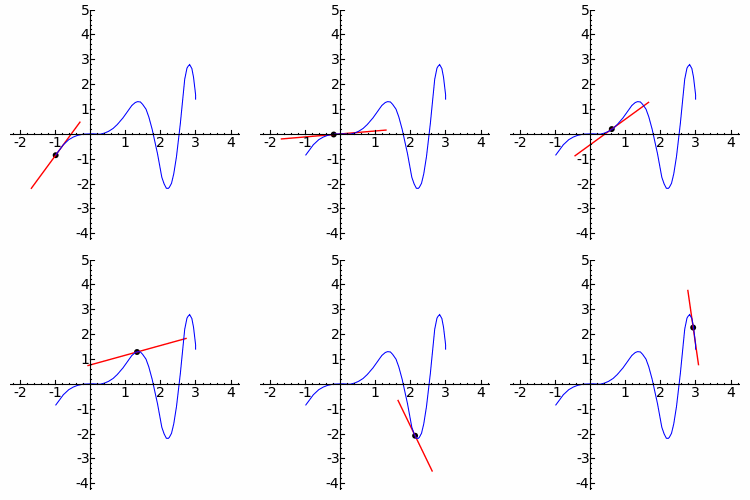
Coming from a laser-focused career in engineering, one day I surprised myself with a desire to beam words onto the page. Maybe I was inspired by the universes of Frank Herbert, H.P. Lovecraft, and Ursula K. Le Guin. Or maybe, as I churned out widgets at my job, I felt a subconscious envy for the dreamcraft of the marketing department. Regardless, I found myself prying into fiction at the Loft, where I was shocked again. A teacher told me that creating “mystery” reminded her of calculus. My ears perked up. I tried to imagine the possibilities of applying Newton’s freaky runes—not to plot trends about those aforementioned widgets, but to explore new universes.
Modern physics began as a quest to resolve paradoxes about radiation and spacetime. Borrowing from that scientific curiosity, I offer a paradox for modern writers: is it possible to count all the meanings a word holds?
Common sense says, “Look in a dictionary, ya dink!” But what happens if we look across dictionaries? Aren’t there variations among definitions? And doesn’t word choice sometimes alter those meanings? Consider the word “neighbor” and the sudden urgency it gathers when neighbors are in need. Or the word “hero.” After all, aren’t we in a terrible moment when neighbors are also heroes? For every Merriam-Webster definition, there is an Oxford English one, an Urban Dictionary one, an ELI5, the word on the street. The existence of these competing definitions points to the never-ending social effort to keep tweaking meaning.
If we look around to people on our left and right, or backward and forward in time, the meanings of words begin to drift. Wyss describes this as the inexorable effect of conversation:
“Every story is actually a conversation, responding to the stories told before it, to the stories told around it, and calling out to the stories that will be told later. Words, the basic tools for storytelling, are collaboratively built, collaboratively owned, and collaboratively used. Their meaning comes from their history in the world, the way they are charged by every human who has ever touched them, the associations writers build for them in stories, and the personal experiences of readers.”
People radiate words and heat. In class, we looked at The Awakening by Isaac Babel, which illustrates how objects become charged with meaning when bombarded by our psychic radiation. The unnamed teenage protagonist badly wants to write stories but struggles against his parents’ dream that he become not just a musician, but a world-famous one. No pressure, kid! Confronted with the limits of his talent, the boy describes his music lessons with something bordering on despair:
“The sounds crawled from my violin like iron filings. I was cut to the heart by those sounds, but Father kept up the pace.”
In the span of two sentences, the violin becomes associated with the scraping sound, the boy’s mental dysphoria, and his father’s obsession. The violin has become charged: we sense that the boy’s shame will propel the story forward, but probably not toward musical achievement. The climax of “The Awakening” demonstrates an even more subtle form of charging. Several months after the scene above, the boy and his father are eating dinner. Dad excitedly tells him that someone else’s son is raking in eight hundred roubles every time he performs. Dad tells him, “Work out how much that comes to at a rate of fifteen concerts per month.” Unbeknownst to his father, the boy has stopped his lessons, and the calculation becomes fraught with guilt. “I worked it out, it came to twelve thousand a month. Doing the multiplication and carrying the four in my head, I looked out the window.”
Even as the dramatic tension mounts, it’s worth maintaining curiosity here. What if we flipped the camera? Rather than seeing the view beyond the protagonist’s unhappy house, perhaps we see a boy who can no longer look at his father for the imaginary pile of roubles between them. The roubles, already charged with the weight of dad’s hopes and dreams, are compounded with the boy’s feelings of inadequacy.
To borrow a term from physics, we can describe the way meaning layers atop the roubles as a “superposition.” In stories, objects come to exist as a superposition of meanings in the reader’s mind. This is weirdly similar to the definition of superposition in quantum physics. In the latter, there is a famous experiment, often performed by sleep-deprived students, called the double-slit experiment. It involves a special laser that emits single photons, i.e. particles of light. The photons pass through one of two possible slits and collide with a screen, where they register as tiny blips. Over time, as the laser emits more and more photons, you can see the blips forming a pattern. Critically, until a photon is detected, it exists in a superposition of all these possible landing sites.
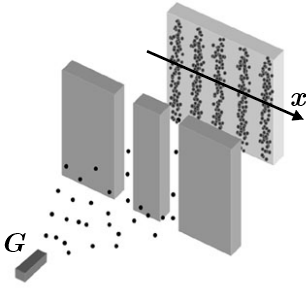
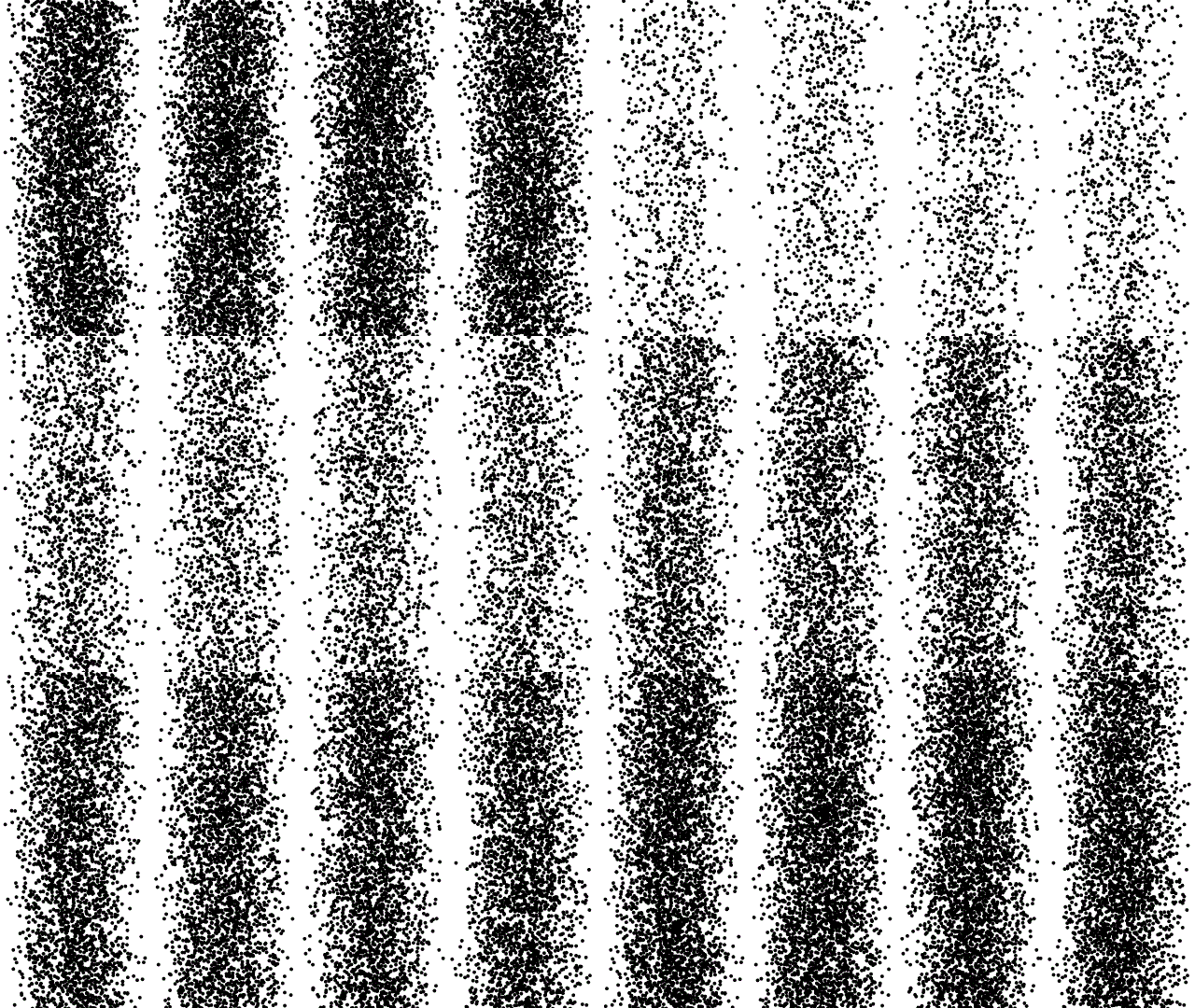
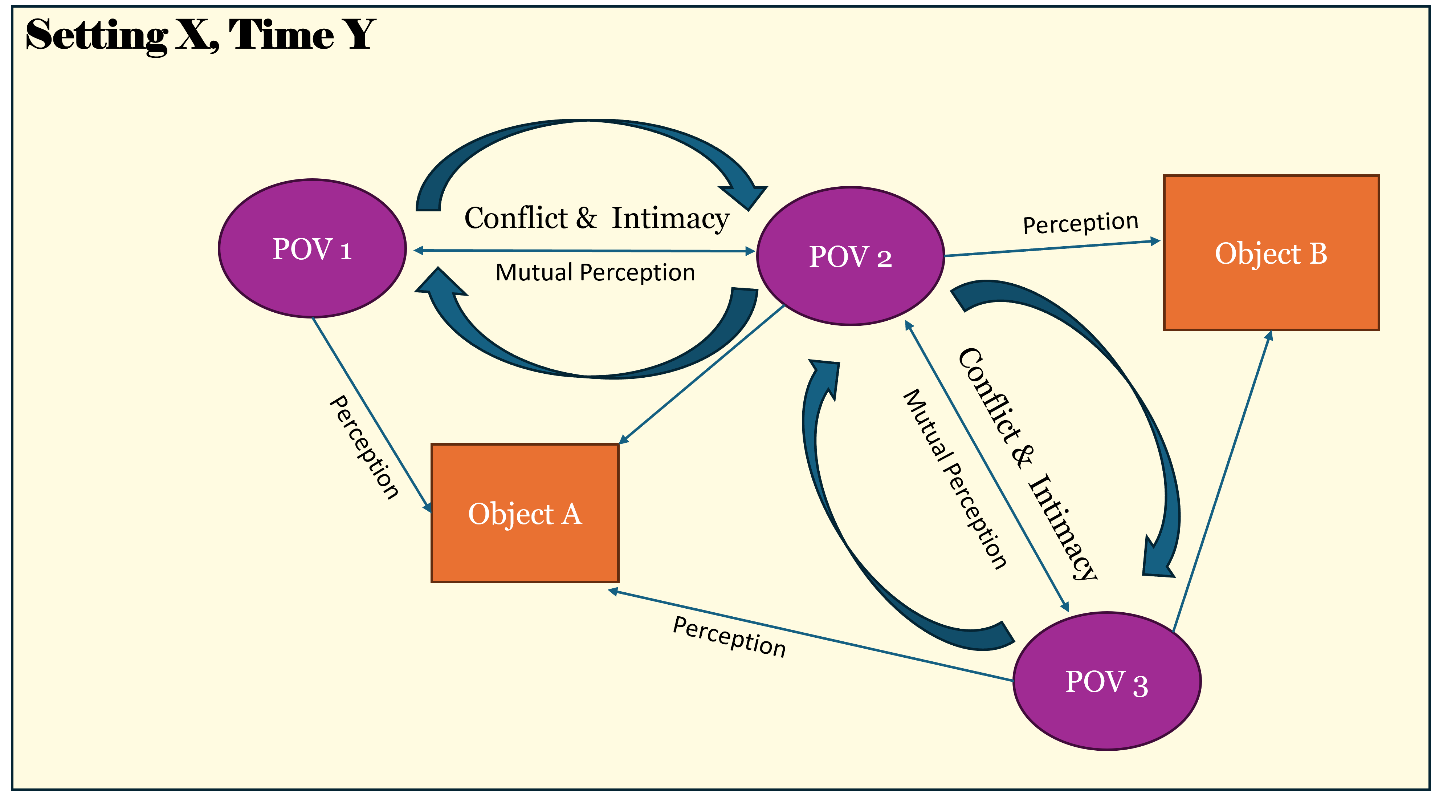
There is a deep parallel here with the writer-reader relationship. In this scenario, the story isn't the laser; it is the series of portals that light can pass through. The laser is the writing process itself: words beamed from brain to page. Through point of view, the writer creates a superposition of meanings, a possibility space that the reader collapses through interpretation. The reader registers the light and feels what they feel based on their own experiences. Perhaps enough blips are registered to sense a pattern, or perhaps not, but undeniably the structure and word choices affect the final result.
Objects thus allow for the storytelling equivalent of measurement. If a physical object exists in multiple states, it’s ambiguous. But put an object in a scene, give it emotional and social stakes, and suddenly your readers will sense the tension! It follows that we can play with our stories, finding psychic depth by shifting the camera between characters and even objects.
From the charged objects in “The Awakening,” we can infer a key unit of organization in stories: the smallest set of perceptions that provokes strong emotion. This can be phrased using Newton’s freaky runes.
Ultimately, in “The Awakening,” both father and son experience emotion in proportion to some physical property, like the pile of roubles. As their perceptions layer atop each other in superposition, the physical world is irradiated with their mental energies. Tension arises. The reader’s stomach lurches as the story enters warp. All future action is foreshadowed by present perceptions. Perception is thus the elementary form, and the mysterious final frontier, of story: drama atomized, meaning quantized. I perceive, therefore I am. Won’t you join us in exploring it?